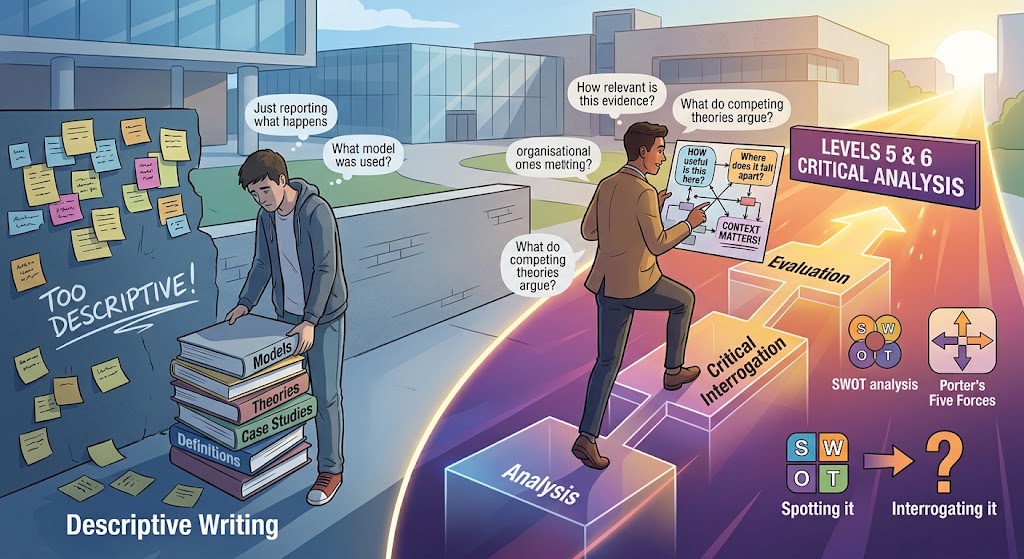
From Descriptive Writing to Critical Analysis in Business Studies

If you’ve ever gotten “too descriptive” scrawled across a business assignment, you’ll know how deflating it feels especially when you’ve read half the module reading list and packed the essay full of theory. But here’s the thing: it’s rarely about how much you know. It’s about what you actually do with that knowledge once it’s on the page.

At undergraduate level, and especially once you hit Levels 4 to 6, business assignments stop rewarding “what does this theory say” and start rewarding “how useful is this theory here, and where does it fall apart.” That’s a genuinely different skill, and nobody really sits students down and explains the shift. You’re just expected to pick it up along the way.

1. What “Critical” Actually Means

Descriptive writing tells the reader what something is what a model proposes, what happened, what the textbook says. Critical analysis asks how convincing, relevant, or limited that explanation actually is once you apply it to a real situation. It’s the difference between reporting and judging.

This gap widens as you move through a degree. At Level 4 you’re mostly proving you understand the basics. By Levels 5 and 6, tutors expect evaluation, comparison, and application though exactly how much depends on the module and the marking criteria your lecturer hands out.

Take SWOT analysis as an everyday example. A descriptive paragraph notes that a company has strong brand recognition as a strength. A critical paragraph asks whether that brand recognition genuinely creates a lasting advantage, what evidence actually backs that claim, and whether it plays out the same way in every market the company operates in. That’s the jump from spotting something to interrogating it.

2. Where Students Usually Go Wrong

A lot of students assume critical writing means arguing against everything, finding fault for the sake of it. It doesn’t. You can be thoroughly critical and still land on the conclusion that a theory is genuinely useful as long as you’ve earned that conclusion through reasoning rather than assumed it.

Another common mix-up is treating “analysis” and “evaluation” as the same thing. Analysis takes an issue apart and looks at how the pieces relate to each other. Evaluation goes further and weighs those pieces up, working toward a judgement you can actually defend.

There’s also a habit of tacking a criticism onto a theory without unpacking it. Saying a model is “limited” tells your marker nothing on its own. Limited how, exactly? Does it fall short for large multinationals, for small entrepreneurial firms, for industries that change quickly? That’s the detail examiners are actually looking for.

3. Theories Worth Knowing Properly

Strategic models, leadership theories, organisational frameworks, marketing approaches, competitive analysis tools these all give you natural openings for critical writing, provided you understand what they’re for rather than just what they say.

You don’t need to memorise every criticism ever levelled at a model. It’s far more useful to understand what it assumes and the kind of problem it was built to solve in the first place. Once you know that, spotting its blind spots becomes much more natural.

Porter’s Five Forces is a good example. It can help explain competitive pressure within an industry, but its value really hinges on whether the five factors actually match the conditions the organisation you’re studying is dealing with. A strong essay shows what the framework reveals, then honestly examines what it misses.

Stakeholder theory works the same way. Naming the different stakeholder groups is descriptive groundwork. Looking at where their interests clash, who holds more power, and what actually happens when a business favours one group over another that’s where the real argument begins to take shape.

Academic sources deserve the same treatment. If two researchers land on different conclusions, that disagreement is a gift it gives you something concrete to weigh up. Look at their assumptions, their evidence, and the context they were working in before deciding whose interpretation fits your question best.

4. What Actually Shapes a Good Answer

The assessment question should steer everything you write. A genuinely well-informed discussion of a business model can still miss the mark badly if the brief asked you to evaluate its usefulness for one specific organisation or problem.

Context matters just as much as the question itself. A theory built around huge established corporations doesn’t always translate cleanly to a small, entrepreneurial business, and evidence drawn from one country or industry shouldn’t be treated as if it applies everywhere. This is exactly the kind of nuance that separates a mid-range mark from a strong one.

Support along the way matters too, and it’s worth being honest about it. A student searching for help to write my business management assignment uk will often find plenty of advice on structure, referencing, and formatting useful, but not the hardest part. The genuinely difficult task is deciding which evidence supports your argument and which is just describing the topic without moving it forward.

There’s also a trade-off between breadth and depth worth remembering. Ten theories skimmed briefly rarely produce a stronger essay than three theories genuinely explored in relation to the actual question you were set.

5. How to Actually Write This Way

Turn each major point into a question before you write it up. Instead of stating “the resource-based view argues valuable resources create competitive advantage,” ask what the theory explains well, what it assumes, whether the evidence backs those assumptions, and whether it genuinely fits the situation you’re analysing.

This shifts how you research from the start. You stop collecting sources purely because they mention your topic and start hunting for evidence that can support, challenge, or complicate the argument you’re building.

It also helps to keep evidence and interpretation clearly separate on the page. A source might establish that a company adopted a certain strategy your job is to explain, in your own reasoning, why it worked or didn’t.

While drafting, check each paragraph is actually moving somewhere. Does it travel from evidence, to explanation, to a judgement? If three paragraphs in a row just introduce another theory or restate what a source says, that section needs more thinking, not more words.

6. Mistakes That Quietly Undermine Your Argument

Words like “however,” “on the other hand,” or “this shows” don’t create critical thinking on their own they just signal that some should be there. If the reasoning behind them is thin, the linking words won’t rescue it.

Listing five limitations of a model rarely helps if none connects back to your actual question. One well-explained, genuinely relevant limitation usually earns more marks than five generic ones bolted on for coverage.

Leaning too heavily on textbooks is another trap. They’re fine for definitions and the basic shape of a model, but proper critical depth usually needs engagement with academic research that argues over how these ideas actually behave in practice.

And don’t force balance where the evidence doesn’t support it. Critical writing doesn’t demand equal airtime for every viewpoint it demands that you consider the credible alternatives fairly, then explain clearly why the evidence points where it does.

Bringing It Together

Moving past descriptive writing isn’t really about sounding more academic. It’s about changing the questions you’re asking yourself while researching and drafting in the first place.

Instead of stopping once you’ve explained what a theory says, push further: what does it assume, where does it stop working, and how does competing evidence change the picture? Then tie every observation straight back to the question you were actually set.

For business students working through Levels 5 and 6, that single habit tends to be the real difference between a piece of writing that shows you’ve read a lot, and one that shows you can genuinely think.

0

Simulations vs. Reality: Documenting FEA, CAD, and Thermodynamic Calculations in Engineering Reports

A finite element model can return a beautifully smooth stress plot and still be wrong in a way that costs marks nobody explained clearly enough during the module. The number on screen looks authoritative precise to several decimal places, colour-coded, confident. Whether it means anything depends entirely on choices made before the solver ever ran: the mesh density, the boundary conditions, the material model, the assumptions baked into the geometry simplification. This is where a lot of final-year mechanical engineering reports quietly fall apart, not because the analysis is wrong, but because the reasoning behind it never makes it onto the page.

Understanding the Topic

Documenting simulation and calculation work properly sits right at the point where mechanical engineering students shift from running software to justifying engineering decisions. Third and fourth-year modules covering FEA, thermodynamics, and CAD-based design reports increasingly assess not whether a student can produce a result, but whether they understand what that result actually represents and where its limits lie.

This matters because industry and academia both treat a raw output as incomplete. A stress value without its boundary conditions, or an efficiency calculation without its stated assumptions, tells an assessor almost nothing about whether the engineer behind it understood the physics involved. Reports at this level are marked on judgement as much as on numerical accuracy, and that shift catches a lot of students off guard after years of coursework where a correct final answer was often enough.

Common Problems or Concerns

The most common issue is presenting a converged mesh result without showing that convergence was actually checked. A single mesh run, however fine, doesn’t demonstrate that the solution is stable it only shows what one particular mesh produced. Markers looking for evidence of mesh independence studies frequently find none, and the analysis loses credibility regardless of how plausible the final number looks.

Boundary conditions cause trouble of a different kind. Students often apply a fixed constraint or a simplified load case because it’s what the tutorial demonstrated, without explaining why that simplification is reasonable for the specific component being analysed. A cantilevered bracket modelled with a perfectly rigid wall support, for instance, rarely matches how the part actually mounts in practice, and failing to acknowledge that gap suggests the simplification wasn’t a deliberate choice at all.

Thermodynamic calculations expose the same weakness in a slightly different guise. Assuming ideal gas behaviour, steady-state conditions, or negligible heat loss might be entirely appropriate but only if the report says so and explains why. Left unstated, these assumptions read as oversights rather than engineering judgement, even when the underlying physics reasoning was sound.

Key Theories or Concepts to Know

Mesh convergence testing is the backbone of credible FEA work: running the same simulation across progressively finer meshes and tracking whether the result of interest stress, deflection, temperature stabilises rather than continuing to shift. A result taken from an unconverged mesh is, strictly speaking, unverified, whatever the plot looks like.

Boundary condition justification asks a related but separate question. Fixed, pinned, and free constraints each carry assumptions about how a component actually interacts with the structures around it, and choosing between them should trace back to the real geometry and loading path, not just the nearest available option in the software’s constraint library.

For thermodynamic work, closed versus open system boundaries, steady-state versus transient conditions, and the validity of ideal-gas assumptions under the given pressure and temperature range are the recurring concepts examiners check for. CAD-based design reports, meanwhile, tend to be assessed on tolerancing decisions and manufacturability reasoning  whether a chosen fit or feature reflects an understanding of how the part will actually be produced, rather than default software settings left unchanged.

Key Factors to Consider

The quality of a simulation-based report tends to come down to how transparently the underlying decisions are documented, rather than how sophisticated the software or the geometry happens to be. A relatively simple analysis explained with full reasoning about mesh choice, constraints, and material properties will usually outperform a more elaborate model presented with no justification at all. The trouble is timing: FEA and thermodynamic reports often land in the same weeks as lab write-ups and design coursework, and a proper mesh convergence study or a fully reasoned set of boundary conditions takes longer to build than most students plan for. That squeeze has made expert mechanical engineering coursework help a familiar search term among students trying to see, before their deadline, what a fully justified, properly documented simulation report actually looks like in practice. What’s worth taking from that isn’t the numbers but the reasoning pattern behind how the report is structured.

Practical Guidance

Run at least three mesh densities and present the trend, not just the final value, showing how the result of interest changes as element size decreases and where it levels off. State explicitly which mesh was used for the reported result and why that level was judged sufficient rather than simply the last one attempted before time ran out.

For boundary conditions, sketch or describe the real mounting or loading arrangement before explaining how it was simplified for the model, and note what that simplification might be hiding stress concentrations at a support, for example, that a perfectly rigid constraint won’t capture. In thermodynamic calculations, state every assumption as a sentence in its own right rather than leaving it implicit in the working: “steady-state conditions were assumed because the process duration exceeds the system’s thermal response time” does far more for a mark than the same assumption sitting unstated behind a formula.

Mistakes to Avoid

Treating a solver’s default settings as correct without questioning them is a frequent and costly habit. Default time steps, convergence criteria, and material properties are starting points, not validated choices, and a report that never questions them signals that the defaults were never actually understood.

Another recurring mistake is comparing simulation results to reality only in passing, or not at all. A report that never asks whether the predicted stress or temperature is physically plausible checked against hand calculations, known material limits, or published data misses the step that distinguishes engineering analysis from software operation.

Students also sometimes overstate confidence in a single result, presenting one mesh, one load case, and one set of assumptions as though it were the only possible answer. Acknowledging where the model could reasonably produce a different result under slightly different assumptions tends to read as stronger engineering judgement, not weaker analysis.

Bringing the Main Lessons Together

A simulation result only becomes an engineering argument once the reasoning behind it is visible on the page the mesh convergence shown, the boundary conditions justified against the real geometry, the assumptions stated rather than buried. None of that requires more advanced software or a more complex model. It requires treating every number as something that needs defending, not just displaying.


Great in the Boardroom, Struggling on the Page: The Real Reason Executive MBA Students Lose Marks

Ask any executive MBA student what surprised them most, and most will say the same thing: writing a report for their board was never this hard. They can summarise a quarter’s performance in three slides and get a director nodding along in under a minute. Then they sit down to write 3,000 words on Porter’s Five Forces and freeze, because the two skills, it turns out, aren’t the same skill at all.

That gap is the single biggest reason capable, experienced professionals lose marks on postgraduate assignments. Corporate writing rewards speed, confidence, and a clean bottom line. Academic writing rewards something slower and more uncomfortable showing your working, questioning your own assumptions, and proving a point rather than simply stating it. Bridging the two isn’t about writing “more academically.” It’s about learning what the marker is actually looking for underneath the words.

  • Why the Frameworks Feel Familiar but Still Go Wrong

PESTEL, Porter’s Five Forces, McKinsey 7S most executive students have used versions of these in real strategy sessions long before their MBA. That familiarity is a trap. In the office, presenting the finished framework is the job done. A board wants the conclusion: which threats matter, where the culture is misaligned, what to do next.

At university, the marker wants to watch you think. They’re less interested in what a SWOT analysis says and far more interested in why you weighted one factor over another, and why that particular framework was the right tool for this particular problem. Picture a student analysing a mid-sized UK manufacturer facing new carbon compliance rules. Simply listing “environmental regulation” under PESTEL earns almost nothing. Tracing exactly how that regulation raises input costs, forces a supplier switch, and compresses margin over eighteen months that’s the analysis actually being marked.

  • Where Executive Students Consistently Lose Marks

The most common fault is writing descriptively instead of critically. A paper opens with three pages on the company’s history and product range, leaving barely enough room to say anything original. Examiners see this constantly, and it’s rarely a knowledge problem it’s a habit problem, carried over from writing that’s meant to inform rather than argue.

Close behind is treating models like checklists. Every box in a SWOT gets filled, every one of Porter’s five forces gets a paragraph, and nothing is weighted against anything else. Real strategic thinking picks the two or three factors that actually matter and goes deep, rather than spreading thin and even. The other trap is presenting opinion as fact. “The market is becoming more competitive” might pass unchallenged in a Monday meeting, but on paper it needs a source, a statistic, or a named competitor’s move behind it otherwise it’s just an assertion wearing the costume of evidence.

This is also where the time squeeze becomes real. Many students already work full-time, and the honest truth is that finding hours to properly research and structure a paper against academic standards, on top of a demanding job, is genuinely difficult which is exactly why some turn to credible academic literature databases or look into reputable MBA assignment writing services purely to understand how a well-structured, properly evidenced paper should actually be built, rather than guessing at university expectations alone. Used that way, as a guide rather than a shortcut, it can clarify what “rigour” looks like in practice far faster than trial and error.

  • The Theory Worth Actually Understanding

PESTEL only earns marks when it’s specific. Naming “technology” as a factor is nearly useless; tracing how a named shift say, the rise of AI-driven SEO tools changes a firm’s cost base or customer acquisition strategy is the difference between a pass and a strong mark.

Porter’s Five Forces works the same way. High-scoring papers don’t just label buyer power as “high.” They explain the mechanism low switching costs, concentrated buyers, easy backward integration because the mechanism is the argument, not the label. McKinsey 7S rewards students who show friction between the hard elements (structure, systems, strategy) and the soft ones (culture, staff, style), particularly during something like a merger, where that friction is usually where the real story lives.

  • Turning the Habit Around

The fix starts with word count discipline. Cap company background at roughly 15% of the paper. The remaining 85% should be framework application, critical evaluation, and evidence not description dressed up as analysis.

Structure sections around findings, not theory names. A heading like “Evaluating Supplier Power in the UK Automotive EV Supply Chain” does more work than “Porter’s Five Forces,” because it signals a conclusion rather than a definition. Pair every claim with a source a report, a dataset, a named academic study and be explicit about a model’s limits. Saying outright that Porter’s framework struggles with fast-moving tech markets shows critical awareness, which markers reward precisely because it proves you’re not treating the model as gospel.

  • Habits Worth Dropping Entirely

Corporate language is the quiet killer of good marks. “Synergy,” “low-hanging fruit,” “paradigm shift” these phrases signal boardroom fluency but read as vague in an academic context. If synergy means cost reduction through shared admin functions, say that plainly instead.

Equally damaging is treating a completed framework as the finished argument. Filling in the matrix is step one; the mark comes from interpreting what the pattern in that matrix actually means for the organisation. And avoid the confident, unsupported action plan the kind that works beautifully in a ten-minute pitch to a director but collapses under a marker’s simple question: what’s this based on?

  • Bringing It Together

The skills that make someone a sharp executive questioning assumptions, weighing evidence, thinking several steps ahead are exactly the skills academic writing is testing. The mismatch isn’t ability. It’s habit.

Once that shift happens background trimmed back, frameworks used as lenses rather than templates, every claim carrying its own evidence the same professional instincts that work in the boardroom start working just as well on the page.

0