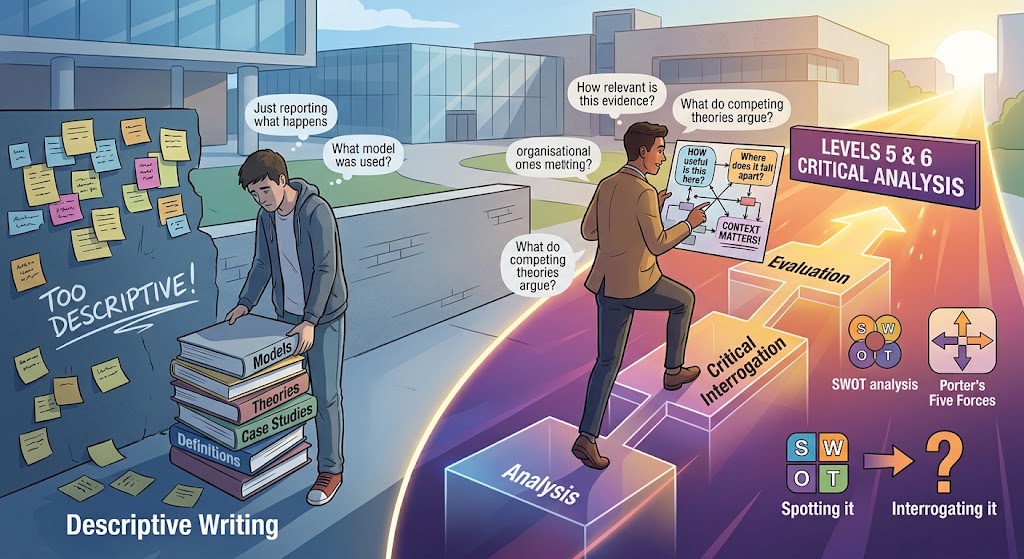
If you’ve ever gotten “too descriptive” scrawled across a business assignment, you’ll know how deflating it feels especially when you’ve read half the module reading list and packed the essay full of theory. But here’s the thing: it’s rarely about how much you know. It’s about what you actually do with that knowledge once it’s on the page.
At undergraduate level, and especially once you hit Levels 4 to 6, business assignments stop rewarding “what does this theory say” and start rewarding “how useful is this theory here, and where does it fall apart.” That’s a genuinely different skill, and nobody really sits students down and explains the shift. You’re just expected to pick it up along the way.
1. What “Critical” Actually Means
Descriptive writing tells the reader what something is what a model proposes, what happened, what the textbook says. Critical analysis asks how convincing, relevant, or limited that explanation actually is once you apply it to a real situation. It’s the difference between reporting and judging.
This gap widens as you move through a degree. At Level 4 you’re mostly proving you understand the basics. By Levels 5 and 6, tutors expect evaluation, comparison, and application though exactly how much depends on the module and the marking criteria your lecturer hands out.
Take SWOT analysis as an everyday example. A descriptive paragraph notes that a company has strong brand recognition as a strength. A critical paragraph asks whether that brand recognition genuinely creates a lasting advantage, what evidence actually backs that claim, and whether it plays out the same way in every market the company operates in. That’s the jump from spotting something to interrogating it.
2. Where Students Usually Go Wrong
A lot of students assume critical writing means arguing against everything, finding fault for the sake of it. It doesn’t. You can be thoroughly critical and still land on the conclusion that a theory is genuinely useful as long as you’ve earned that conclusion through reasoning rather than assumed it.
Another common mix-up is treating “analysis” and “evaluation” as the same thing. Analysis takes an issue apart and looks at how the pieces relate to each other. Evaluation goes further and weighs those pieces up, working toward a judgement you can actually defend.
There’s also a habit of tacking a criticism onto a theory without unpacking it. Saying a model is “limited” tells your marker nothing on its own. Limited how, exactly? Does it fall short for large multinationals, for small entrepreneurial firms, for industries that change quickly? That’s the detail examiners are actually looking for.
3. Theories Worth Knowing Properly
Strategic models, leadership theories, organisational frameworks, marketing approaches, competitive analysis tools these all give you natural openings for critical writing, provided you understand what they’re for rather than just what they say.
You don’t need to memorise every criticism ever levelled at a model. It’s far more useful to understand what it assumes and the kind of problem it was built to solve in the first place. Once you know that, spotting its blind spots becomes much more natural.
Porter’s Five Forces is a good example. It can help explain competitive pressure within an industry, but its value really hinges on whether the five factors actually match the conditions the organisation you’re studying is dealing with. A strong essay shows what the framework reveals, then honestly examines what it misses.
Stakeholder theory works the same way. Naming the different stakeholder groups is descriptive groundwork. Looking at where their interests clash, who holds more power, and what actually happens when a business favours one group over another that’s where the real argument begins to take shape.
Academic sources deserve the same treatment. If two researchers land on different conclusions, that disagreement is a gift it gives you something concrete to weigh up. Look at their assumptions, their evidence, and the context they were working in before deciding whose interpretation fits your question best.
4. What Actually Shapes a Good Answer
The assessment question should steer everything you write. A genuinely well-informed discussion of a business model can still miss the mark badly if the brief asked you to evaluate its usefulness for one specific organisation or problem.
Context matters just as much as the question itself. A theory built around huge established corporations doesn’t always translate cleanly to a small, entrepreneurial business, and evidence drawn from one country or industry shouldn’t be treated as if it applies everywhere. This is exactly the kind of nuance that separates a mid-range mark from a strong one.
Support along the way matters too, and it’s worth being honest about it. A student searching for help to write my business management assignment uk will often find plenty of advice on structure, referencing, and formatting useful, but not the hardest part. The genuinely difficult task is deciding which evidence supports your argument and which is just describing the topic without moving it forward.
There’s also a trade-off between breadth and depth worth remembering. Ten theories skimmed briefly rarely produce a stronger essay than three theories genuinely explored in relation to the actual question you were set.
5. How to Actually Write This Way
Turn each major point into a question before you write it up. Instead of stating “the resource-based view argues valuable resources create competitive advantage,” ask what the theory explains well, what it assumes, whether the evidence backs those assumptions, and whether it genuinely fits the situation you’re analysing.
This shifts how you research from the start. You stop collecting sources purely because they mention your topic and start hunting for evidence that can support, challenge, or complicate the argument you’re building.
It also helps to keep evidence and interpretation clearly separate on the page. A source might establish that a company adopted a certain strategy your job is to explain, in your own reasoning, why it worked or didn’t.
While drafting, check each paragraph is actually moving somewhere. Does it travel from evidence, to explanation, to a judgement? If three paragraphs in a row just introduce another theory or restate what a source says, that section needs more thinking, not more words.
6. Mistakes That Quietly Undermine Your Argument
Words like “however,” “on the other hand,” or “this shows” don’t create critical thinking on their own they just signal that some should be there. If the reasoning behind them is thin, the linking words won’t rescue it.
Listing five limitations of a model rarely helps if none connects back to your actual question. One well-explained, genuinely relevant limitation usually earns more marks than five generic ones bolted on for coverage.
Leaning too heavily on textbooks is another trap. They’re fine for definitions and the basic shape of a model, but proper critical depth usually needs engagement with academic research that argues over how these ideas actually behave in practice.
And don’t force balance where the evidence doesn’t support it. Critical writing doesn’t demand equal airtime for every viewpoint it demands that you consider the credible alternatives fairly, then explain clearly why the evidence points where it does.
Bringing It Together
Moving past descriptive writing isn’t really about sounding more academic. It’s about changing the questions you’re asking yourself while researching and drafting in the first place.
Instead of stopping once you’ve explained what a theory says, push further: what does it assume, where does it stop working, and how does competing evidence change the picture? Then tie every observation straight back to the question you were actually set.
For business students working through Levels 5 and 6, that single habit tends to be the real difference between a piece of writing that shows you’ve read a lot, and one that shows you can genuinely think.
0
Rate this business
Have you heard of this business? Do you like it? How do you like it?
Check out if it is in the list of Top Rated Small Businesses