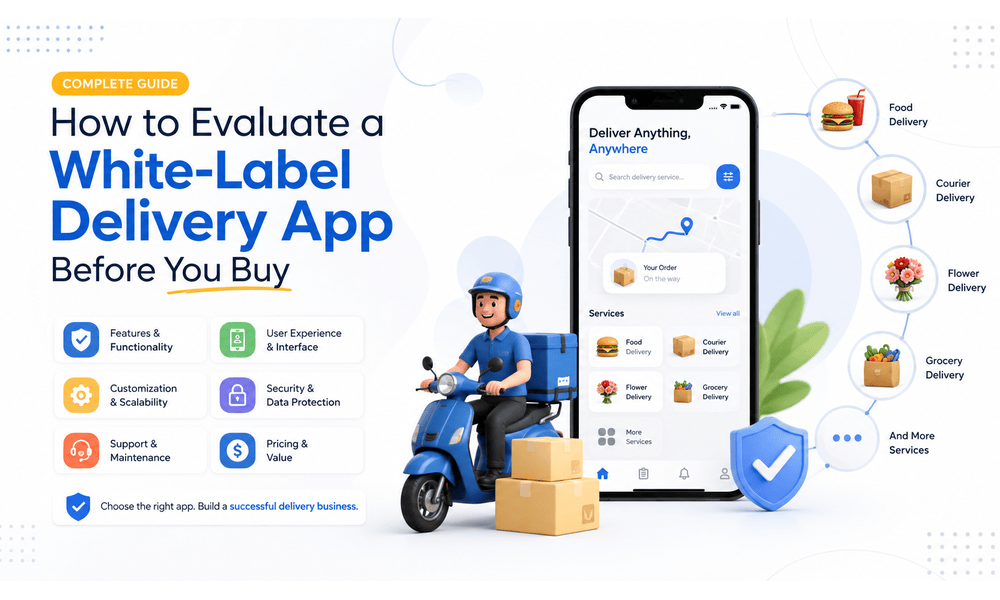
Customer expectations have changed across nearly every delivery-based business. Whether you’re delivering restaurant meals, groceries, pharmacy products, retail orders, or courier packages, customers expect a fast, reliable, and convenient experience. To meet these expectations without investing months in software development, many businesses choose a white-label delivery app.
A ready-made platform can significantly reduce the time and effort required to launch a delivery service, but not every solution offers the same value. Some provide extensive customization and room for future growth, while others may limit your business with restricted features, hidden costs, or poor support. Taking the time to evaluate a platform before making a purchase can help you avoid expensive changes later.
This guide explains what a white-label delivery app is, why choosing the right one matters, and the key factors every business should consider before making an investment.
What Is a White-Label Delivery App?
A white-label delivery app is a pre-built software solution that businesses can rebrand and customize as their own. Instead of developing an application from scratch, companies use an existing platform and replace the original branding with their own logo, colors, business name, and other visual elements. This allows them to launch a branded delivery service much faster than building a custom application.
Unlike custom app development, where every feature is designed and coded from the ground up, a white-label solution comes with the essential delivery functionality already in place. Businesses can focus on configuring the platform to match their operations instead of spending months on development, testing, and deployment.
White-label delivery software is used across many industries. Restaurants manage online food orders, grocery stores offer same-day delivery, pharmacies deliver prescriptions, courier companies streamline logistics, and retailers provide local delivery services. Because the core platform is already available, businesses can enter the market more quickly while reducing development costs.
Although the concept is straightforward, choosing the right provider requires careful evaluation. Factors such as customization, scalability, security, integrations, and ongoing support can vary significantly between platforms, making it important to compare solutions beyond their feature lists.
Why Choosing the Right White-Label Delivery App Matters
A delivery platform becomes part of your daily business operations. It handles customer orders, payment processing, delivery management, and communication between customers, drivers, and administrators. The quality of the platform directly affects how efficiently these tasks are managed.
Selecting the right solution isn’t just about finding the longest list of features. A platform that works well today should also support your business as it grows. It should adapt to increasing order volumes, changing customer expectations, and new business opportunities without requiring major redevelopment.
Evaluating a white-label delivery app before purchasing helps you identify a solution that delivers long-term value instead of creating operational challenges later. The following factors can help you compare platforms more effectively and make a more informed decision.
10 Things to Evaluate Before Buying a White-Label Delivery App
1. Customization and Branding
One of the biggest advantages of a white-label platform is the ability to build your own brand without developing software from scratch. However, the level of customization varies from one provider to another.
Look beyond basic branding options such as logos and color schemes. A good platform should allow you to customize the customer app, driver app, and admin panel to reflect your business identity. Depending on your requirements, you may also need support for multiple languages, currencies, delivery preferences, or business-specific workflows.
Choosing a customizable delivery app helps create a consistent brand experience while giving your business the flexibility to evolve over time.
2. Core Delivery Features
Every delivery business has unique operational needs, but certain features are essential regardless of the industry.
A reliable delivery app solution should include order management, real-time order tracking, delivery scheduling, secure payment processing, push notifications, and a user-friendly admin dashboard. These features help businesses monitor operations efficiently while keeping customers informed throughout the delivery process.
Instead of comparing platforms based on the number of available features, focus on whether the core functionality supports your day-to-day operations and delivers a smooth experience for customers, delivery personnel, and administrators.
3. Scalability
The platform you choose today should be able to support your business tomorrow.
As your customer base grows, you may expand into new locations, add delivery partners, or introduce additional services. Your software should be capable of handling increased order volumes without affecting performance or reliability.
A scalable on-demand delivery platform also makes it easier to support multiple stores, service areas, or business models without replacing your existing system. Planning for future growth early can save both time and operational costs as your business evolves.
4. Third-Party Integrations
Most delivery businesses rely on multiple digital tools to manage their operations. Your delivery platform should work seamlessly with these systems instead of creating additional manual tasks.
Before making a purchase, check whether the platform supports integrations with payment gateways, digital maps, POS systems, CRM software, analytics tools, and other business applications you already use. If your business has unique operational requirements, API availability is equally important for future integrations.
Well-planned integrations improve workflow efficiency, reduce duplicate work, and help different parts of your business communicate more effectively. A delivery management software platform that connects smoothly with your existing systems can simplify operations and support future business growth.
5. Security and Reliability
A delivery app handles sensitive information, including customer details, addresses, payment transactions, and order history. Protecting this data should be a priority when evaluating any platform.
Ask potential vendors about their security practices. Look for features such as secure payment processing, encrypted data transmission, regular backups, and role-based access controls. It’s also worth understanding how the platform handles software updates and system maintenance to minimize security risks.
Reliability matters just as much. Frequent downtime or slow performance can disrupt deliveries and affect customer satisfaction. A dependable platform should provide consistent performance, especially during busy periods when order volumes increase.
6. User Experience
Even the most feature-rich platform can become difficult to manage if the user experience is poor. Customers expect an app that’s simple to navigate, while drivers and administrators need tools that help them complete tasks efficiently.
When evaluating a platform, pay attention to the overall interface. Is the ordering process straightforward? Can drivers easily manage deliveries? Is the admin dashboard organized and easy to understand?
A well-designed application reduces confusion, shortens training time, and encourages repeat usage. Small improvements in usability often have a noticeable impact on customer satisfaction and day-to-day operations.
7. Vendor Support and Updates
Buying a white-label delivery app is only the beginning of the relationship with your software provider. Ongoing support becomes important once your platform is live.
Before making a decision, understand what type of assistance is included. Find out whether technical support is available during business hours or around the clock, how issues are reported, and how quickly they are typically resolved.
It’s also helpful to ask about future product updates. Regular improvements help keep the platform compatible with changing technologies, customer expectations, and security requirements. Choosing a provider that actively maintains its product can reduce future maintenance challenges.
8. Pricing and Total Cost
The lowest price doesn’t always represent the best value. Some platforms have affordable upfront costs but charge additional fees for customization, upgrades, integrations, or ongoing maintenance.
Instead of comparing licensing costs alone, look at the total cost of ownership. Consider implementation expenses, future enhancements, technical support, and any recurring charges that may apply after launch.
Understanding the complete investment helps you compare solutions fairly and avoid unexpected costs later.
9. Vendor Experience and Reputation
The company behind the software is just as important as the software itself.
Review the provider’s experience with delivery platforms and similar projects. Explore their portfolio, read client testimonials, and look for evidence that the platform has been successfully implemented across different business types.
A provider with industry experience is more likely to understand operational challenges and continue improving the product based on real customer feedback. While no vendor is perfect, a proven track record can provide greater confidence in your decision.
10. Deployment Time and Future Flexibility
One of the main reasons businesses choose a white-label solution is to launch more quickly. However, deployment timelines can vary depending on customization requirements and implementation processes.
Ask how long the platform typically takes to configure, test, and launch. At the same time, think beyond the initial release. Your business may introduce new services, expand into different regions, or adopt new technologies over time.
Choosing a platform that can adapt to future changes is often more valuable than one that only meets your immediate needs. Flexibility reduces the likelihood of rebuilding your software as your business grows.
Common Mistakes Buyers Should Avoid
Many businesses focus on comparing features but overlook factors that have a greater impact after launch.
One common mistake is choosing the cheapest option without considering long-term value. Lower upfront costs may lead to additional expenses for maintenance, upgrades, or custom development later.
Another mistake is ignoring scalability. A platform that works well for a small operation may struggle as order volumes increase or the business expands into new markets.
Some buyers also overlook the importance of vendor support. Technical issues are inevitable, and responsive support can make a significant difference in resolving problems quickly.
Finally, avoid making a decision without requesting a product demonstration or trial. Seeing the platform in action provides a better understanding of its usability and helps confirm whether it meets your operational requirements.
Questions to Ask Before Making Your Final Decision
Before choosing a provider, prepare a few practical questions to help compare your options.
– What features are included in the standard license?
– Are future software updates included?
– How much customization is available?
– Can the platform support multiple locations or delivery services?
– Which third-party integrations are supported?
– What type of technical support is available after launch?
– How long does implementation typically take?
– Are there any additional maintenance or upgrade costs?
Clear answers to these questions can help you identify the solution that best fits your business requirements.
Conclusion
Choosing a white-label delivery app is an important business decision that goes beyond comparing feature lists or pricing. The right platform should support your current operations while providing the flexibility to grow with your business over time.
By evaluating factors such as customization, scalability, security, integrations, vendor support, and long-term costs, you can make a more informed decision and reduce the risk of costly changes after launch.
If you’re exploring different solutions, take the time to compare providers carefully, request demonstrations, and assess how well each platform aligns with your business goals. A thoughtful evaluation today can help you build a delivery service that’s prepared for tomorrow.
Frequently Asked Questions
What is a white-label delivery app?
A white-label delivery app is a ready-made delivery platform that businesses can customize with their own branding instead of developing an application from scratch.
How is it different from custom app development?
Custom development builds software specifically for one business, while a white-label solution provides a pre-built platform that can be customized and deployed much faster.
Can I customize the app for my brand?
Most white-label platforms support branding customization, including logos, colors, business information, and in many cases additional interface and workflow modifications.
How long does deployment usually take?
Deployment depends on the provider and the level of customization required. Since the core platform is already developed, implementation is generally faster than custom software development.
Can one platform support multiple delivery services?
Many modern platforms support multiple delivery models, allowing businesses to manage services such as food, grocery, pharmacy, courier, and retail deliveries from a single solution.
Is a white-label delivery app suitable for startups?
Yes. Many startups choose white-label solutions because they reduce development time, lower initial investment, and allow businesses to launch and validate their ideas more quickly.
Rate this business
Have you heard of this business? Do you like it? How do you like it?
Check out if it is in the list of Top Rated Small Businesses